Showing posts with label millennials. Show all posts

Thursday, February 15, 2007

Librarians - Get 'Geeky' with it!


Well... what it comes down to this. Librarians, we need you to make a 'leap of faith.' There is no better way to do it than to say, we need you to come and try Web 2.0. I have read posts over the past year from David Warlick, Wesley Fryer and a cast of others about librarians. I am encouraged by what I see from librarians just finishing their Library Service credentials from schools like San Jose State University, but I also see many librarians sticking with the tried and true online databases that have the information 'cherry-picked' for the students. I ask librarians about using these resources with students and the answer that always comes back is "Why not use these sources, they have been checked out and we know the information is valid." I personally have two problems with this. First, I think that the information that is provided by some of these online databases is usually several months old by the time it is listed. Nothing new or topical that increases student interest is included. Secondly, we create a false sense of security with our students that all of the material on the Internet is trustworthy. The arguement that I get back from Librarians is that, "Wikipedia is edited by members and therefore cannot be considered a 'trustworthy' source." OK... Does inaccurate information get into Wikipedia? Absolutely, but inaccurate information gets into any encyclopedia on the planet. What's the difference? In Wikipedia, the information gets updated almost immediately once it is deemed to be inaccurate, with a print encyclopedia, it takes several months to years to get the information correct. Wesley Fryer had a great post on this point. How fast was Wikipedia changed when Pluto's status was downgraded from being a planet to a star? Almost instantaneously... Look at the time of the press conference and the time Wikipedia was edited to refelect that change. How many print encyclopedias still have Pluto as a planet? Almost all of them. Look around schools... There is misinformation everywhere! How many maps and encyclopedias are there still in classrooms and Libraries that show a united 'Soviet Union?' Shouldn't it be our goal as educators to provide the best and most accurate information possible to our students?

How do we do this? Well, we need you Librarians! We need you to get get a little 'geeky' with it! We need you to embrace some of the new technologies and techniques to find and validate information.

1) Wikipedia is a source. No better or worse than anyother, but it is one source and should never be used in isolation without corroboration from other sources. This is true for 'every' source students use in preparing reports. This also includes text books, newspapers, magazines and teachers!

2) Students, Teachers and Librarians need to be trained in how to locate, validate and think critically about information. We should be skeptical about all information until we can validate it. The one thing we haven't done a great job of in the past and we need to in the future, is to evaluate the 'bias potential' for any information or web site we encounter on the Internet. Every teacher and student should know how to perform a "site search," a "link search" and an "whois search."

3) Libraries need to be restructured into collaborative learning and sharing spaces. There are way too many new libraries being built today that look identical to the facilities that were built in the 1950's. Like it or not, the way information is collected and stored have changed over the last 50 years and we need to have facilities that allow for the effective use and manipulation of that information. The type of information we are collecting and archiving today has also changed. Audio and video files are now collected in huge repositories on the Internet. I would make the case that 'YouTube' and 'Google Video' are nothing more than an online video libraries that can be searched like any other library.

So, my feeling is that we decrease the number of subscription databases we subscribe to (not eliminate) and spend the money we are using to subscribe to services to provide additional professional development opportunities for Librarians and Teachers. Some librarians have gotten the point of Web 2.0, like this one! Joyce Valenza in Pennsylvania has a great matrix of how information has changed and how the role of Librarians will continue to change. There is even an online course for librarians to create a "Social Library."

Make these skills available to all and include them in the curriculum. We need to give these tools to all people involved in the educational process and allow them to use them create new structures that can be built upon by those that follow them. Information in the 21st Century is not static, where each successive generation learns the same material and may add some additional skills or theories for improving the practice of some particular action. The goal of education in the past was to possess information that would allow you to perform a particular skill. Today, possessing information that can be recalled via human memory is inefficient for the most part. The skill set we teach should be concentrated on how to access and use the information available to solve questions that the environment or society puts to us on a daily basis. It's not enough to possess a certain set of facts anymore, its what you can do with the information you have access to is what is going to make the difference for the students we have in our classrooms today.

Librarians... we want to be your partners. Meet us at 2.0 and we'll travel together!

Friday, February 09, 2007

Information Literacy: The Points of the STAR

With the explosion of Web 2.0 and all of the media surrounding it, it is hard to escape hearing or seeing some example of its use in our daily lives. Along a somewhat parallel path has been a 'School 2.0' discussion that has traveled along the web. While there has not been an explosion of Web 2.0 tools used in schools, there are many instances where you can see these tools in use. Due to the role in society where schools are found, change in education is often a slow and often tedious process. In most cases, when you start talking about change in education, it is often some recycled program or idea that has been repackaged and sold as something new.

This is different. Information Literacy is on everone's mind now... and trying to define how that will look in schools is definitely starting to take shape. In my own mind, I want to define it for myself, so that I can accurately define and articulate it for other teachers and members of the community. So, this is just one way I started organizing things so that I can speak to teachers and members of the community and make sure I hit all the right 'talking points.'

So, here we go!

As I started looking at this I wanted to have a visual model where I could quickly draw in front of someone and have a few words connected to it that would organize my thoughts. Your own model may be completely different, but I am looking at this as a mini-graphic organizer.

I decided to use a 'star' as my organizing point. It's quick, easy to use and I can draw one with out much assistance, despite my lacking artistic skills. If you think of colors and light, the combination of all colors in light produces 'white light,' which is where all members of the school community need to be. Everyone needs to be able to see everything, it needs to be 'transparent.' Transparency, has become the new educational 'buzz word' of the day, taking over from 'ubuqitous.' In the model, where the white light is are: Students, Teachers, other Adults and Retention. The students, teachers and other adults are obvious, but the reason I added 'retention' was that I wanted to emphasize a 'shared set of skills and experiences' that will facilitate the conversation between all of the other three groups. The center of the star becomes the focal point of the five points that surround it. Each point taken separately sheds some light on the center of the star, but only when all five points of the star combine their light together do they become 'white light' or transparent.

So, what are the five points?

1) Tools / Applications: The tools of the Web 2.0 are now for the most part free. If you purchase a computer and have an Internet connection, most of what you want to do, you can find a tool for free that will allow you to do it. Some come connected with ads, others dont, but the point to be made here is that the 'point of entry' into the digital world has come very close to zero. It makes me understand Nicholas Negroponte even more. What tools... Open Office, Blogger, Google Docs and Spreadsheets, SketchUp, Google Earth, Picasa, Google Pages, Glifffy, wikis and the list could go on and on. The other issue surrounding 'point of entry' is the increasing power of cell phones becoming a computing tool. Everytime I do an SMS search infront of a new group of teachers, watching their eyes get really big and do a search with their own cell phone it is a very cool thing.

2) Relevance: As students and others move through there lives, there is always a desire to find ways to give meaning to the things that are part of our lives. Students are already using e-mail, text messaging, Instant Messaging, Social Networking sites (MySpace, Friendster), podcasts and online video (YouTube, Google Video). The use of Web 2.0 tools in education, which students are already using to connect to each other, gives them a level of comfort that is traditionally missing in most classrooms with desks in rows and a teacher standing at the front lecturing away.

3) Validation: Being able discern the difference between fact and fiction is an important skill in the lives of all adults today. But the even deeper importance comes from being able use information in a meaningful way. Search strategies, using the 'advanced search' functions of Google, the Way Back Machine and other search engines, allow students and others to find the history of different web pages, as well as sites linking to and sites being linked to.

4) Ethics: As part of the process of introducing a new 'Literacy' into schools, we need to understand that students do not understand many of the implications of their behavior in the connected society of today. This is something that many of us as adults have just learned over the past couple of years. Imagine turning the clock forward 10 years on the students we have today and the ability of a future spouse or employer performing a search on them and digging up some blog post or random reference on a web page that may not portray them in the most positive light. It has already been well documented where colleges and employers are using searches to determine admission and hiring practices. As part of the Global Communications curriulum, we included an entire unit on Digital Citizenship, much of which we used the material by Bailey and Ribble from Kansas State University.

5) Synthesis: Putting it all together is the key to all of this. Whether you call it remixing, synergy, mashup, sampling or something else, the goal of Web 2.0 and School 2.0 is to take the material available to students and synthesize it into something new and different. Once you have brought several ideas into a new form, you need to share that in some way, through a graphic, a podcast, blog post, video, etc. As students, and others, become more comfortable with this process of bringing together ideas from several different sources and sharing them out, it starts a conversation.

The conversation is what this is all about... We want students and their teachers and other adults in their lives to have a conversation. This conversation will take many forms, but it ultimately create situation where students will learn to work collaboratively with others towards a common goal and learn to teach themselves. This process will allow them to solve the issues that will undoubtedly face in their adult lives.

I once wrote an article about coaching, and the first line said, "Teachers and coaches are the biggest thieves known to mankind." I still believe this, but I need to refine it and say, "Teachers and Coaches are the biggest facilitators known to mankind." This is the role of teachers, where we become the facilitators of learning, not the source of it. In the past, teachers performed the remixing, mashup, sampling function for the students we teach, we did this for several reasons. First, it allowed us to have a deeper understanding of the curriculum we were teaching and improve our ability to relate the knowledge we had to the students. Secondly, we drew upon our own experiences in school, knowing that we didn't automatically 'get it' the first time the teacher introduced material and developed different ways to represent the same knowledge. Anyone that has been a teacher more than a few minutes has heard the phrase that we are moving from being "the sage on the stage, to the guide on the side." It is now time to really test all of that out.

In developing all of this I have taken and remixed and mashed up all of the things I have read and experienced over the last 2 years from: Alan November, Will Richardson, David Warlick, Miguel Guhlin, Wesley Fryer, Chris Walsh, Mike Lawrence, the Google Teacher's Academy, Vicki Davis, David Pogue, Mark Wagner, Kathleen Ferenz and a countless band of others that I read and interact with. I have not met all of these people face to face, but that is the strength of the new literacy, the ability to have the conversation, regardless of time or location.

So, to finish in the words of Dennis Miller.... ' of course I could be wrong.'

Saturday, November 18, 2006

Monterey Tech 06 - David Warlick Keynote

We just finished listening to David Warlick's keynote at the Monterey CLMS / CUE Conference. The one word I can use to describe what David said was, "Validating." Many of the issues David brought up during his talk were issues we (Myself, Dominic and Geoff) spoke about in our session here yesterday. We put up a page of links we discussed on the Global Communications Wiki.

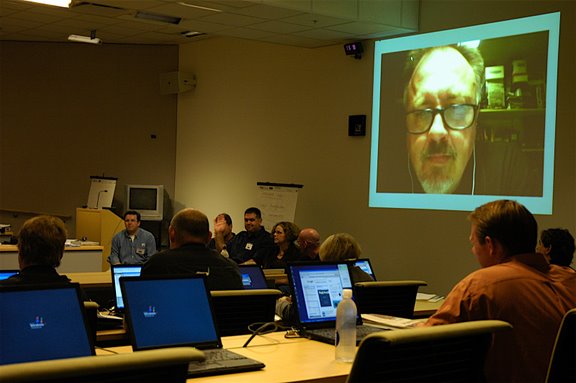
The picture here is from the "Google Teacher Academy" day where David was part of our conversation about the "New Literacy" via tele-conference.

David discussed the issues we face today in teaching the students we have in our classes and how the structure of the classroom we teach in is better suited for the industrial society of the past instead of the connected, ubiquitous, always ready to go students we have today. The one analogy that was particularly useful to me was the idea of students having 'tentacles.' Students have tentacles that connect them to the world around them. Myspace, cell phones, multi-player online gaming allow students to connect to their world, not just the world they can touch, but the world they can't touch miles or contentents away. In our classrooms, we cut our students tentatcles! We take the tools they are using away from them. In our presentation yesterday, we discussed the 'disconnect' between a student's personal use of technology and their academic use of technology. When I went to promote the "Global Communicatons" program to 8th graders at our middle school, I asked them how many of them had a "Web Presence?" None of the students raised their hands. When I asked them, how many of them either had or knew of someone that has a "Myspace" account. Every hand went in the air. Now, you might be saying that I did this in a room of thirty 8th Graders. No, there were over 300 students in the room.

Another topic that I focused in on was the integration of the idea of the 'flat classroom.' I have written responses to David on his blog about this in the past, but today, I felt that using the idea that classrooms are made up of energy. And in the past, the energy in a classroom was created by 'gravity' created by the teacher being 'superior' to the students, not just in knowledge, but in stature in the fact that the teacher's desk was larger than the student desk and in many times on a podium. In a scientific sense, gravity creates friction and therfore creates energy in that way. In the 'flat classroom' there is not a source of friction, since the teacher and students are at the same level. So, how do we create energy in a 'flat classroom?' My feeling is that the energy in a flat classroom comes from a 'chemical reaction' of students and teachers collaborating with each other and the energy that is created by the 'conversation' that takes place between students, with themselves, and teacher.

Driving and maintaining audiences: This point also hit home with me, since I am currently reading a book, called 'Convergence Culture' by Henry Jenkins. The idea behind 'Convergence Culture,' is that we are connected to multiple media sources and that there is an interaction between the creators of the media and the consumers. Where the consumer now has an interactive relationship with the media they consume. This manifests itself in items like fan websites created to figure out who will win the next 'Survivor' or the next 'American Idol' competition. Fans making home movies or writing stories using the characters from 'Star Wars' or 'The Matrix.' The idea of interaction between the creators and comsumers of media interacting with each other and the consumer deepening the experience for themselves and others is intriguing and will only get bigger.

The last thing David mentioned was close to the quote I use as the quote on this blog. "There is a big difference between teaching thirty years and teaching one year thirty times."