Showing posts with label literacy. Show all posts

Friday, February 09, 2007

Information Literacy: The Points of the STAR

With the explosion of Web 2.0 and all of the media surrounding it, it is hard to escape hearing or seeing some example of its use in our daily lives. Along a somewhat parallel path has been a 'School 2.0' discussion that has traveled along the web. While there has not been an explosion of Web 2.0 tools used in schools, there are many instances where you can see these tools in use. Due to the role in society where schools are found, change in education is often a slow and often tedious process. In most cases, when you start talking about change in education, it is often some recycled program or idea that has been repackaged and sold as something new.

This is different. Information Literacy is on everone's mind now... and trying to define how that will look in schools is definitely starting to take shape. In my own mind, I want to define it for myself, so that I can accurately define and articulate it for other teachers and members of the community. So, this is just one way I started organizing things so that I can speak to teachers and members of the community and make sure I hit all the right 'talking points.'

So, here we go!

As I started looking at this I wanted to have a visual model where I could quickly draw in front of someone and have a few words connected to it that would organize my thoughts. Your own model may be completely different, but I am looking at this as a mini-graphic organizer.

I decided to use a 'star' as my organizing point. It's quick, easy to use and I can draw one with out much assistance, despite my lacking artistic skills. If you think of colors and light, the combination of all colors in light produces 'white light,' which is where all members of the school community need to be. Everyone needs to be able to see everything, it needs to be 'transparent.' Transparency, has become the new educational 'buzz word' of the day, taking over from 'ubuqitous.' In the model, where the white light is are: Students, Teachers, other Adults and Retention. The students, teachers and other adults are obvious, but the reason I added 'retention' was that I wanted to emphasize a 'shared set of skills and experiences' that will facilitate the conversation between all of the other three groups. The center of the star becomes the focal point of the five points that surround it. Each point taken separately sheds some light on the center of the star, but only when all five points of the star combine their light together do they become 'white light' or transparent.

So, what are the five points?

1) Tools / Applications: The tools of the Web 2.0 are now for the most part free. If you purchase a computer and have an Internet connection, most of what you want to do, you can find a tool for free that will allow you to do it. Some come connected with ads, others dont, but the point to be made here is that the 'point of entry' into the digital world has come very close to zero. It makes me understand Nicholas Negroponte even more. What tools... Open Office, Blogger, Google Docs and Spreadsheets, SketchUp, Google Earth, Picasa, Google Pages, Glifffy, wikis and the list could go on and on. The other issue surrounding 'point of entry' is the increasing power of cell phones becoming a computing tool. Everytime I do an SMS search infront of a new group of teachers, watching their eyes get really big and do a search with their own cell phone it is a very cool thing.

2) Relevance: As students and others move through there lives, there is always a desire to find ways to give meaning to the things that are part of our lives. Students are already using e-mail, text messaging, Instant Messaging, Social Networking sites (MySpace, Friendster), podcasts and online video (YouTube, Google Video). The use of Web 2.0 tools in education, which students are already using to connect to each other, gives them a level of comfort that is traditionally missing in most classrooms with desks in rows and a teacher standing at the front lecturing away.

3) Validation: Being able discern the difference between fact and fiction is an important skill in the lives of all adults today. But the even deeper importance comes from being able use information in a meaningful way. Search strategies, using the 'advanced search' functions of Google, the Way Back Machine and other search engines, allow students and others to find the history of different web pages, as well as sites linking to and sites being linked to.

4) Ethics: As part of the process of introducing a new 'Literacy' into schools, we need to understand that students do not understand many of the implications of their behavior in the connected society of today. This is something that many of us as adults have just learned over the past couple of years. Imagine turning the clock forward 10 years on the students we have today and the ability of a future spouse or employer performing a search on them and digging up some blog post or random reference on a web page that may not portray them in the most positive light. It has already been well documented where colleges and employers are using searches to determine admission and hiring practices. As part of the Global Communications curriulum, we included an entire unit on Digital Citizenship, much of which we used the material by Bailey and Ribble from Kansas State University.

5) Synthesis: Putting it all together is the key to all of this. Whether you call it remixing, synergy, mashup, sampling or something else, the goal of Web 2.0 and School 2.0 is to take the material available to students and synthesize it into something new and different. Once you have brought several ideas into a new form, you need to share that in some way, through a graphic, a podcast, blog post, video, etc. As students, and others, become more comfortable with this process of bringing together ideas from several different sources and sharing them out, it starts a conversation.

The conversation is what this is all about... We want students and their teachers and other adults in their lives to have a conversation. This conversation will take many forms, but it ultimately create situation where students will learn to work collaboratively with others towards a common goal and learn to teach themselves. This process will allow them to solve the issues that will undoubtedly face in their adult lives.

I once wrote an article about coaching, and the first line said, "Teachers and coaches are the biggest thieves known to mankind." I still believe this, but I need to refine it and say, "Teachers and Coaches are the biggest facilitators known to mankind." This is the role of teachers, where we become the facilitators of learning, not the source of it. In the past, teachers performed the remixing, mashup, sampling function for the students we teach, we did this for several reasons. First, it allowed us to have a deeper understanding of the curriculum we were teaching and improve our ability to relate the knowledge we had to the students. Secondly, we drew upon our own experiences in school, knowing that we didn't automatically 'get it' the first time the teacher introduced material and developed different ways to represent the same knowledge. Anyone that has been a teacher more than a few minutes has heard the phrase that we are moving from being "the sage on the stage, to the guide on the side." It is now time to really test all of that out.

In developing all of this I have taken and remixed and mashed up all of the things I have read and experienced over the last 2 years from: Alan November, Will Richardson, David Warlick, Miguel Guhlin, Wesley Fryer, Chris Walsh, Mike Lawrence, the Google Teacher's Academy, Vicki Davis, David Pogue, Mark Wagner, Kathleen Ferenz and a countless band of others that I read and interact with. I have not met all of these people face to face, but that is the strength of the new literacy, the ability to have the conversation, regardless of time or location.

So, to finish in the words of Dennis Miller.... ' of course I could be wrong.'

Sunday, November 05, 2006

Guerrilla Education: A Way to Move Forward


Over the past few days I have been reading the blog posts from many of the educational bloggers (Will Richardson, David Warlick and Miguel Guhlin) and finding most are concerned that the opportunity for meaningful change in the educational process is getting bogged down by an educational bureaucracy that has Educational Technology Directors and Administrators creating road blocks for meaningful change. Most teachers say they want to use wikis, blogs and other collaborative tools in their classrooms, yet most will use these tools as a way to do the same assignment using a different medium. Shovelware is a term that is used to describe this process of using a new technology in the same way an older technology had been used.

So, what's a different approach to take in this process? The evangelist label has been used many different ways in reference to technology and tech integration. You can go back to the beginnings at Apple Computer, where the employees were referred to as Evangelists. Guy Kawasaki, a venture capitalist and former Apple Computer Evangelist, has written extensively on the subject in his books and on his blog, "How to Change the World. Will Richardson, currently on the cover of 'Teacher' magazine, with the headline, "The Blogvangelist", has also embraced this persona in his work with teachers around the country. “The new Internet isn’t about technology anymore” says, Richardson. “Instead, it’s about your imagination, about thinking, quite literally, ‘out of the box’ of the traditional classroom.”

What we are really talking about is changing the roles in the traditional classroom. The classrooms of today are still based on the industrial / assembly line model where the teacher is in possession of the knowledge that is used in the class and the students are expected to be willing receipients of the teacher's knowledge. Will Richardson, in his evangelism, is working to convert the teachers toward the 'new literacy skills' using blogs, wikis, RSS, etc. He has been successful with many teachers, and these are teachers willing to implement these tools into their classes, yet there are still significant road blocks in the way. Some of the road blocks are real and others are imagined, yet they get the same result. Teachers are not able to implement these tools and skills into their teaching repertoire.

I want to change this slightly, evangelism is described as 'converting' others who will in turn go out and spread the tools they have learned. I would like to change the practice over to being a guerrilla. Now, I understand that there may be a negative connotation towards the term 'guerrilla,' but that is also part of the attraction to using that term. It definitely catches your eye and draws your attention to it. So, what meanings am I trying to express by using the term 'guerrilla' to describe the implementation of EdTech skills? First, I want to emphasize the idea that there is a small group of committed individuals working collaboratively to liberate others from a larger governmental group. (read: school bureaucracy) Secondly, I want to emphasize the idea that guerrillas use speed, mobility and tactics that draw their opposition out into 'terrain' that is more advantageous to their skills.

How would we implement such tactics within an educational setting?

1) Assess your current resources.
- What do you have access to that you can use with students to acquire the Information Literacy skills they need?
* Can your students access blogs on campus? Are there certain blogs that are blocked and others that are allowed through your district filters? Have you checked which sites are really blocked or are you going by the word of mouth of another teacher?
* Miguel Guhlin's Walled Garden of Web 2.0 tools
* Blog post from Great Britain dealing with the same issue
- What resources do you wish you had access to, but don't because of some roadblock (real or imagined) that are in your way?
* Search for open source and web based alternatives and make a list. Using open source or web alternatives diffuse the 'cost' issue that so frequently are thrown in the face of educators that are trying to educate and innovate.

2) Assess your Administration:
- What are their objections? Can you build alliances with the site administrators to allow question the district level 'gatekeepers' directly or with their help?
* Sit down with your site level administrators and find their mental roadblocks and remove them quickly and easily. You aren't going to be exiled to Siberia, and your administrators will welcome your leadership and problem solving.
* Show your site level administrators the benefits of using these skills. E-mail them your blog posts (if you have a blog) and articles from the Internet that support the use of these skills.
* Do some 'reconnaissance' on district level administrators. Talk with people around your district to find out what their objections are and why are some sites blocked. Have answers/solutions to those objections ready to go.

3) Know the rules and find ways around them
- What does the district have students and teachers sign when they agree to using technology on campus? What does the Acceptable Use Policy of the district say? Are there other district bylaws or administrative regulations that are in force regarding the use of technology?
* Act like a 'loose constructionist.' I am not asking you to violate the rules and regulations of your district, but if there isn't something specific forbidding you from doing something that is safe and educationally sound. I would start working on it and developing lessons for the classroom and showing the benefit to students.
* NOTE: I am not encouraging you to publically oppose your administration, but I am bringing the focus back to where it should be. On the students.

These tactics may not solve the issues that are in place in your district, but they will give you good working knowledge of what the issues are and how you might start to find ways to change them to help your students.

Friday, October 13, 2006

Possums, Tails and Literacy


The last few weeks has had more than its share of ups and downs to last awhile, therefore the blogging was put on the back burner. Now, that everything has quieted down a little I can get back to pushing the literacy agenda again. In my best southern accent I want to say, "Friends, I have a word for you today. That word is 'Literacy.' It's all about giving to our students... giving our students the gift of life long literacy."

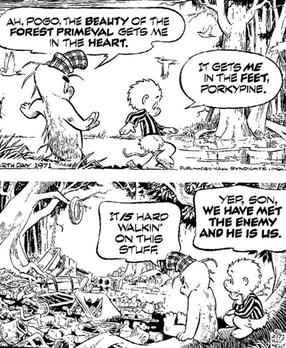
Over the past few months, I have written about integrating technology, but in some of the things I have read over the past few weeks, I have been wrong about this. Integrating technology isn't something we should think of as separate from literacy as a whole, it is an integral part of what will be necessary to be considered literate in the world our students will spend their adult life in. So, to quote the Pogo cartoonist, Walt Kelly, "We have met the enemy and he is us."


To clarify what I mean, I think that teachers and the educational establishment have been barriers to the 'new literacy' in our schools. The skills that we think constitute 'information literacy' in the past truly support and enhance what we think of as 'traditional literacy' skills. Currently, we think of literacy as 'possessing' a certain number of facts and the ability to apply them to situations that present themselves to us in our everyday life. In the society our students will live in, it will be impossible for them to 'possess' all of the knowledge that will be necessary to work in the society of the future. The current definition of 'Information Literacy' includes: defining, locating, selecting/analyzing and organizing/synthesizing. It is these last two sets of skills that are the most important to our students.

The way schools have been organized over the last 100 years have been based on the Industrial Manufacturing model, with students traveling from class to class, like an assembly line, to have 4 quarts of History or English poured into their bodies. Henry Ford would be so proud! Educational pundits have recoginized that this model has been flawed when they use analogies that the teacher needs to stop being the 'Sage on the Stage' and move over an become the 'Guide on the side.' So, what will it take for us to move toward a model like this?

Like all 'new' ideas, especially those in education, they usually come into being from some type of business model. And 'New Literacy' models come from business as well. A new theory of collective intelligence and collaborative creation of knowledge comes from a book called, 'The Long Tail.' Want to see a little of what is meant by the 'Long Tail,' check out this video on the Long Tail Blog. David Warlick, one of the most respected Information Literacy authorities (lecturer, blogger, author) wrote about his interpretations of the Long Tail on his blog.

Next Steps:
1) Sign up for a Bloglines or Google Reader account. There is a video on the Google Reader site that will teach you about adding feeds to your reader.

2) Subscribe to 4 RSS feeds and read them at least every other day. Make sure these are feeds you are interested in.

3) Create a Blogger account and write a blog. Your audience could be for you, to get your ideas on paper. Your friends, to discuss the latest ideas, books, the weather, etc. Your class, to identify blog postings or other articles you have found on the Internet that will bring greater definition to what you are teaching in class.

If you need help. You can always contact me... I will come out to help. There have been 5 people that have contacted me about some of the things I have written here and I have either personally connected with everyone, either in person or e-mail, and sent links or helped them set up an account. There is one person I need to get back to and make sure they are ready to go. One of the teachers at Capuchino is currently on leave and living in Hong Kong, before he left he asked me how to set up a mailing list so he could keep in touch with all of the students that want to stay connected to him... I told him to start a blog. Check out the Hong Kong Chronicles.....

Happy Blogging and e-mail me when you create your blog so I can subscribe.