Sunday, January 02, 2011

New Year - New Tech Strategy - Week 1

With the beginning of the New Year, we all make some resolutions that we want to make this year a bit better than the last.  I am no different in this regard, I tweeted this afternoon that my New Year's Resolutions were to Tweet once a day, Blog once a week and to work on being healthier by joining Steve Dembo's Fit42 Fitness Challenge.  I am hopeful that I will be able to achieve all of these goals.  In the Blogging arena, I am going to resurrect this blog.  I had posted regularly between 2005 and 2008, but when I took the position as the Administrative Vice Principal at Woodside High School, it left me little time to blog.

 I have continued to present at a variety of Education Conferences in California and I have done some presentations for CUE, in their CUE to You program.  I was also elected to the CUE Board of Directors in April 2010, so I have continued to be very active in the EdTech community, but I have been less on the cutting-edge than I had been in the past and I realized that I very much miss the implementation of new and emerging technologies in the educational process and having conversations with my colleagues, local and around the world.  I am hopeful that this blog will allow me to jump back into the conversation and re-engage with all of you.

With that said..... here we go!


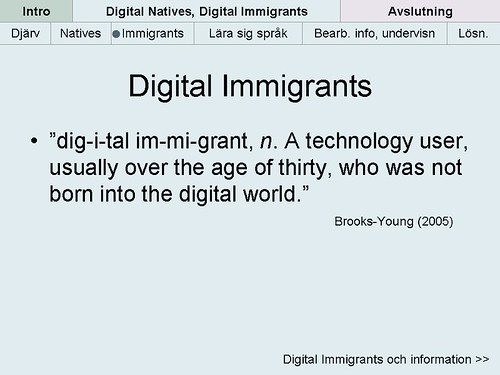
One of my rallying cries over the past several years has been to increase the amount of technology that is used as part of the educational process.  I have been a huge proponent of this since the mid-1990's.  I have always had to deal with some teachers that refused to integrate technology into their classes for a myriad of reasons.  One of which was always access and the other was that because they were "seasoned" teachers they couldn't learn how to use technology like their younger counterparts.  Teachers in this group typically held up copies of Marc Prensky's "Digital Natives, Digital Immigrants," as a justification of their position.  While I think that Marc Prensky is an intelligent man, I want to let him know that while he may have just identified behavior that he observed in educational settings, he set the integration of technology into education back at least 5 years.  I know that there are other factors that come into play, including: unions, finances, professional development, standards, NCLB, etc., but the "Digital Natives, Digital Immigrants" gave teachers the easy out.

Next week.... Access, Access - 2011 is going to be the year when we get so close to "ubiquitous access" and there won't be any more excuses.

Sunday, August 29, 2010

The First Penguin

 I have spent the past couple of weeks getting through Randy Pausch's "The Last Lecture."  I have found it to be real, poignant and inspiring.  If you aren't familiar with the book or the theme; Randy, a computer science professor working in the virtual reality field at Carnegie Mellon University, has found out that he has pancreatic cancer and will soon succumb to the disease.  The book is a collection of his hopes for his wife, family and students.  He delivers these in a "Last Lecture" at Carnegie Mellon for his students.

In most computer science fields, those who are really at the cutting edge of the field have to take risks.  Many times expending time and energy in projects that won't work.  To recognize his students who were attempting to create something new and exciting, but failed to get the desired result, he created the "First Penguin Award." (p.148-149) When in the Antarctic, Penguins travel in groups, but there always must be a "First Penguin" that dives into the water without knowing what is there.  There could be predators that could quickly feast on that first penguin, but the first penguin also gets an opportunity to make a mark in the field and learn so much in the process.   Randy would award the group in his class with the most spectacular failure a stuffed penguin as a recognition of their efforts.


In the Educational Technology field, there are plenty of "First Penguins" out there, who can assist those coming into the field in how to navigate through the issues that arise anytime you try something new as an educator.  Randy starts the section with the quote, "Experience is what you get when you didn't get what you wanted."  Some have had some huge successes after some initial failures, and some continue to be that "First Penguin" working to make a difference in a field where the institutional predators are often times the most dangerous.  When I eventually become a principal at a high school, I will be looking for some "First Penguins" to come to my school.  Fortunately, I will be able to give them some assurances that I have cleared the water of some of the typical predators.

Friday, July 09, 2010

Sifting Through Infowhelm


Over the past several months I have definitely been experiencing "Infowhelm." In my position as the Administrative Vice Principal at Woodside High School, I don't have as much time as I used to to explore everything that was happening in the "EdTech Blogosphere." And there were a lot of things going on besides school, I was on the road a little bit presenting at the annual CUE conference in Palm Springs in March, a few one day professional development sessions, a three day session with Administrators in Georgetown, KY and getting elected to the CUE Board of Directors.

So, my personal professional development took a back seat as evidenced by the lack of posts on this blog and the number of items in my Google Reader account growing to over 1,000 several times during the past 6 months. As you can see from the graphic on the left, my Google Reader account now has no unread items in it. No, I didn't hit the "reset" switch by clicking on "Mark all items read." You can see that there are certain things I found interesting during the past 6 months, but taking a peek at my "Shared Items" list in Google Reader.

One of the items in this list is a short video that was shared by Lucy Gray, a great educator from Chicago, whom I have never met, but we have definitely traveled in the same circles in EdTech. The video illustrates the exponential growth of information in our society today and points out that we are still largely teaching "content" in schools instead of "Information Fluency" skills.


Will Richardson posted this morning on the same topic. What are we teaching? Are we teaching kids how to be better test takers? Are we teaching them how to get into the college of their choice? What should we be teaching them? In my mind, we need to change that paradigm and start teaching skills that will allow them to possess the skills that will be necessary in the economy they will be competing in. Thinking, evaluating, collaborating, applying skill, problem solving, etc. Or as Seth Godin sets forth in his book that is my current reading material, Linchpin, that "schools should teach students how to solve interesting problems."

One way I have seen recently to teach students how to solve interesting problems has been the work of Dan Meyer and his presentation at TEDxNYED. His 4 step process is clearly laid out in the presentation below.


I hope that some of you will see this an comment about where we should be going and how do we get there. I welcome your comments.

Saturday, December 26, 2009

We Have No Excuse!


Over the past few days, while I have been on break, I have been mulling around the blogosphere looking at all of the things that have been going on. I got completely caught up on reading everything in my Google Reader and even engaged with David Jakes, Gary Stager and others over the validity and the content of a GTA designed for Administrators. I know it has been awhile since I have posted anything here, but I want to post more as my time permits.

This post may not be something that my colleagues in education will necessarily agree with, but in the words of Kathy Sierra, its time to "get out of default mode." I am seriously thinking of using the slogan when I present on the last day of the CLHS Statewide Conference in Monterey, CA on January 17, 2010.

So, here we go! We have no excuse any more. Teachers need to get out of default mode. I am tired of teacher's complaining that they cannot assign any Internet based assignments because students do not have access at home. At the present time, any student that does not have access to the Internet does not have it because they have chosen not to have access. This is despite the economic situation of their families.

Currently, Walmart is advertizing an e-Machine's Netbook for $228 and have an Acer Netbook for $298. The prices are so low that the major cell phone services will give you a free or low cost netbook in exchange for a two year service agreement. (AT&T and Verizon)

The locations offering free Wifi is increasing by the day. McDonald's (12,804 locations in the US) just announced that they will have free Internet access starting during January 2010. Starbucks (11,068 locations in the US) has offered 2 hours free per day, in exchange for registering your card and using the card once a month. Barnes and Noble has 777 locations and Borders Books has 517 locations offering free Wifi. Panera Bread has 1,272 locations in the US offering free Wifi. Add to this number locations at Public Libraries, Apple Stores, Schlotsky's Deli, Daily Grind and the variety of independent businesses offering free Wifi, there is simply no excuse any more. In my local community, there are two cities that have municipal Wifi networks. (Mountain View and East Palo Alto)

If there are still barriers, the one technology that people in the lower socio-economic groups have adopted in large numbers has been the cell phone. Over the last two years, 2007-2009, the number of smart phones (iPhones, Droids and BlackBerry's) has increased by 20% per year and will account for close to 150 million cell phones in the US by 2013. Will Richardson's post earlier this month about allowing students to use their own connection, is borne out by these numbers.

So, if there are those teachers in the profession who still want to hang on to the argument that they will not assign students work that necessitates students using Internet resources, please send them my way. I have a few resources I would like to share with them.

Friday, July 31, 2009

Global, Mobile, Ubiquitous and Cheap


Those four words have been the rallying cry for most of Clay Shirky's recent talks at TED@State and other venues recently, speaking about how the media landscape is changing at a rapid rate. In one of my previous posts I mentioned the video you can watch on the subject along with the keynote presentation I did at the Harker Teacher Institute in June. In that keynote, "Jumping the Educational Shark," a reference to the social phenomena that Skirky identifies as the "cognitive surplus" of time that people in industrialized countries had after World War II that was taken up by the "sitcom." And my own reference to the phrase "Jumping the Shark," which is common in television, when a show has peaked and is definitely beginning to slide into the abyss and is making one last effort to bring viewers back before the show is eventually cancelled.

My point in the keynote was to express the idea that the educational community has many people trying desperately to hold on to the old industrial model of education that resembles an assembly line, but not recognizing that it is no longer useful to prepare students for the world they will live in during their adult lives. One of the arguments of this group was that we couldn't assign students work to do using computers or the Internet because not all students had access to those tools. Access has been improving steadily over the past few years and now, I truly believe this argument is no longer valid. If students want a computer, they cost about as much as a cell phone and if they want to use that device to access the Internet, there is free access at at variety of locations. This came into focus for me over the past three days. First, I read that Barnes and Noble is another national business, along with Panera Bread and Starbucks that is providing free Internet access to their patrons. Secondly, all of the public libraries in San Mateo County, where I teach, provide free wifi access as well. Third, the City of East Palo Alto, where some of our neediest kids live, has a free municipal wifi program that covers most of the city, called "wifi101." (Here is a link to their coverage map.)

Along with these developments, the Pew Internet and Life Project published a new report about how people are accessing the Internet and more than half (56%) have done so using a wireless connection through a phone or wifi. Some may say that the number is low, but there are some issues that are brought to light when you dig a little deeper. The first is that the use of wifi or accessing the Internet through a 'smart phone' has been completely demystified. It is common place in our society and people can assist those who are trying to make the leap into the wireless world. Secondly, the group showing the greatest percentage of gain is African Americans.
"African Americans are the most active users of the mobile internet – and their use of it is also growing the fastest. This means the digital divide between African Americans and white Americans diminishes when mobile use is taken into account."

So, to me the divide has been bridged. If a student wants access, it is available. They might need to jump through a hoop or two, but there is access and in most instances it is free. What does this mean to education, especially in my school. The on-going rhetoric from teacher's that they cannot assign work to students that would require them to access the Internet or use some type of technology is no longer valid. To me, as an administrator, the message is clear: Teachers you need to move forward and use these tools to engage students in the educational process. A blog post that crossed past me this week says it about as good as I could ever home to. It is from the "TeachPaperless" blog and it is titled, "Top Eleven Things Teachers Need to Know About Technology."

Image: www.thumbjockey.com

Friday, July 24, 2009

How Society Has Changed...

Well... this is a different type of post than I usually post here. Since almost all of them deal with Educational Technology in some way. This post is more of an observation of society and how times have changed in the last 20+ years.

I went and saw the film, "I Love You, Beth Cooper," yesterday. It is the normal teen fare, where there is some overt sexuality, the local bully gets put in his place and the nerdy guy finds out what life is like as part of the "popular clique." The main character, Denis professes his unrequited love to the head cheerleader. The rest of the film is a bunch of teen antics, but the underlying story shows that Denis is on his way to Stanford in the fall and on to a very successful adult life. The object of his affection, Beth, may have reached the apex of her life in High School and may never reach a higher status than the one she had.

The other film that it brought to mind was one that was somewhat similar was "Ferris Bueller's Day Off," which is a classic for most of the people in my generation. I can remember seeing the film in my early 20's and thinking this guy has the whole world "wired." Ferris is a cool and hip schemer, who is about to graduate from High School and go off to college, is trying to have one last great day with his girlfriend and somewhat nerdy best friend and before he graduates.

But here is what I wanted to compare between the two films. Denis' father in "Beth Cooper," is played by Alan Ruck. There is a scene, where Denis' father gives him a bottle of champagne to celebrate his High School graduation and tells him where there are condom's for him to use should the need arise. He does this because he recognizes that his son has worked hard to get accepted in to Stanford and says that, "there won't be much time for Toga Parties with your pre-Med curriculum." In "Ferris Bueller," the smart and somewhat nerdy best friend, Cameron Frye, is played by ... Alan Ruck. Same guy, 23 years later. Cameron has real issues with his father, there is little or no communication between the two, which frustrates Cameron. At the movie's climax, Cameron intentionally bashes in his father's prized vintage Ferrari to force the two of them to talk.

I will make the point here, that Alan Ruck in "Beth Cooper," plays the type of father he wanted to have when he was in "Ferris Bueller." Is this the evolution of our contemporary society, or have we recognized that we have to work with our kids to assist them in dealing with the social issues that they have to confront as teens.

As teachers, we deal with these issues on a daily basis, with a variety of students at completely different places along the social continuum, how we support them as they move forward in their journey towards adulthood is definitely part of what we do to create a whole person.
Sunday, July 12, 2009

Leadership Day 2009


I wanted to post today to Scott McLeod's Leadership Day request, because I see myself in a situation that is different than most administrators and therefore, most educational leaders in the US today. As most of you know who have read this blog in the past, I have worked in EdTech circles for quite some time. I am one of the first 50 Google Certified Teacher's and I have moved forward into the administrative ranks for the express purpose to move the use of technology in the educational process forward.

There are two video's that really point the direction of the use of technology in education. There aren't many who believe that using technology in education is going to be detrimental, but many are not advocates, since they do not have any personal knowledge or experience in integrating technology into the classroom. There are two video's that have come out in the past two weeks that will really move the use of technology in education forward. The biggest reason is that the cost of most of the techology has become $0.00. That is right, NOTHING! And if school districts plan and make the right deals with textbook publishers, there will be a cost saving. If the country were to bring into practice, what California is talking about with online open source textbooks, the cost savings would be remarkable.

The first video is the quick speech that Clay Shirky, the author of last year's "Here Comes Everybody." Shirky makes the point that the explosion of Internet technologies have made the media of today, "Global, Mobile, Ubiquitous and Cheap." Cheap $200-$250 netbooks can provide a huge amount of processing power in a small package, which schools could provide to students at an even lower cost given the savings of bulk purchases.


The second video is the preview of Chris Anderson's new book, "Free: The Past and Future of a Radical Price." This is a followup to his best seller, "The Long Tail" from 2004. Anderson makes the point that bandwidth, processing power and storage capacity has increased so much and has become so cheap that the cost of producing these items is virtually $0.00. This has a huge impact on education, since we are always facing budget cut backs and technology never seems to be a priority. If Anderson's premise is true, the future of education is going to involve more and more technology.


The last issue is the fact that California is undertaking with open source text books in Math and Science. Governor Schwarzenegger would like to have this all in place by the beginning of the next school year. This would push the textbook publishers to make additional material and even e-book versions of their texts available to schools.

We'll have to see how all of this plays out.... but the prospects are interesting.